Size matters more than effect
In the bathroom the choice of size comes before the aesthetic one, and it is the only decision that is hard to correct afterwards. The reason is that the bathroom is the smallest and most interrupted room in the home: sanitaryware, shower tray, niches and service runs create an irregular perimeter, and every obstacle becomes a cut.
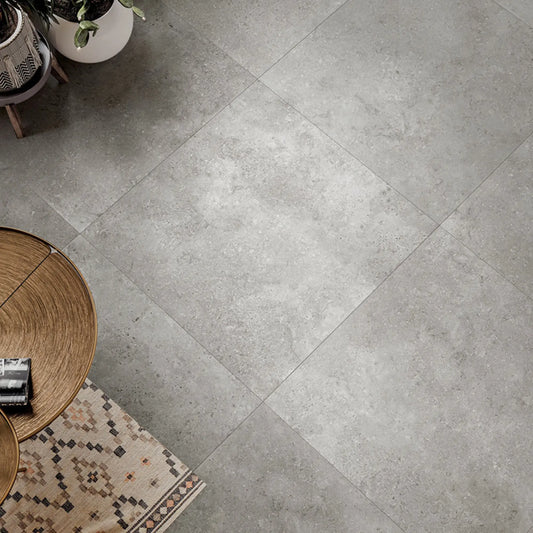
Of the twelve sizes available, the ones that hold up best under six square metres are 60x60 and 30x60, where whole tiles are many and waste stays contained. 60x120 and the medium squares, 80x80 and 90x90, also work at that floor area because they reduce the grout lines while staying adaptable to a broken perimeter. 60x120 is the most requested: the continuous surface widens the room visually.
120x120 is available across almost every effect but asks for free runs to show whole tiles: it performs best in large bathrooms and on long walls. 30x60, at the opposite end, remains the reference for wall laying.
Which of the six effects to choose
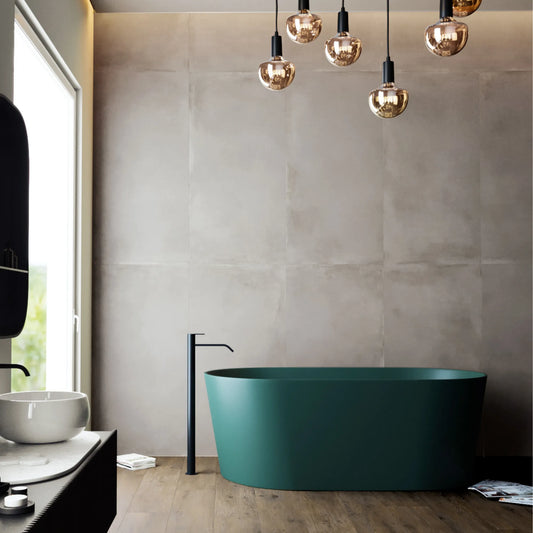
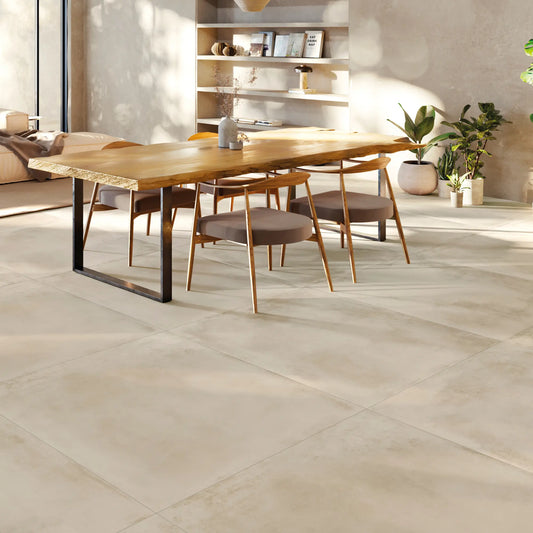
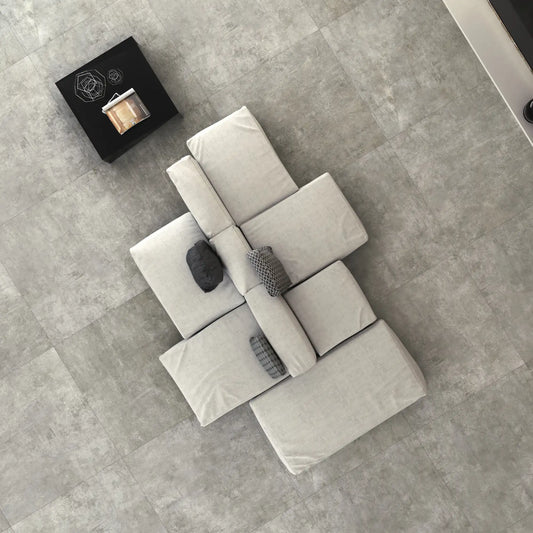
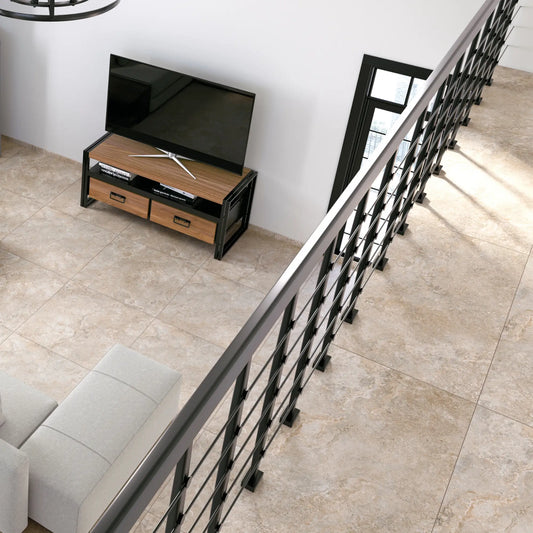
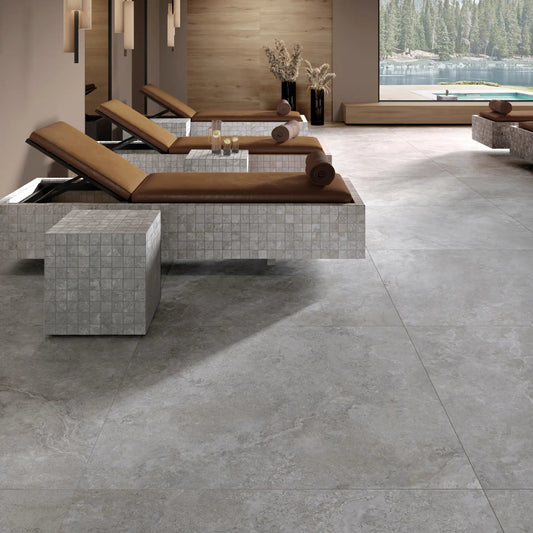
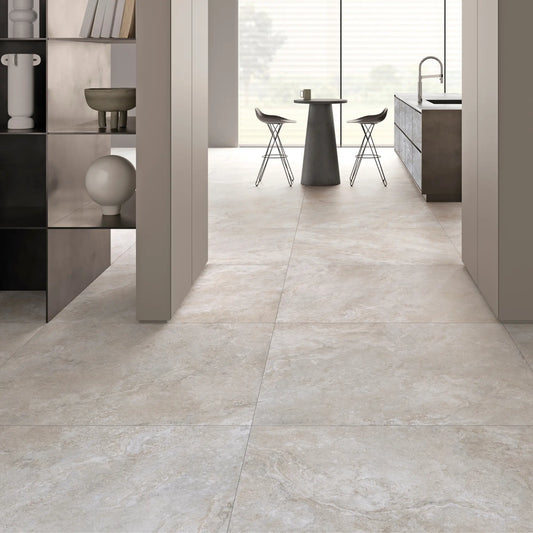
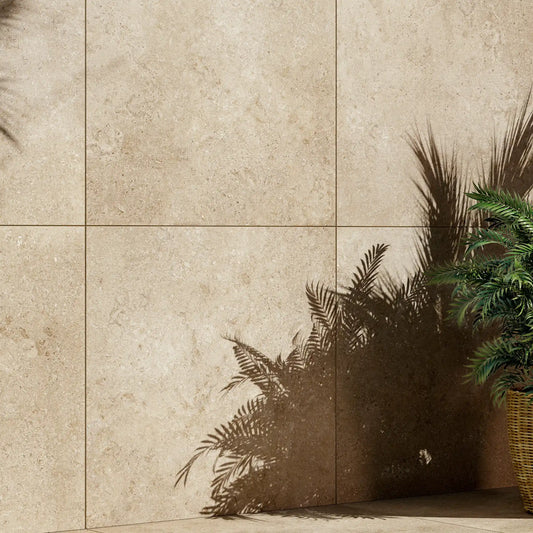
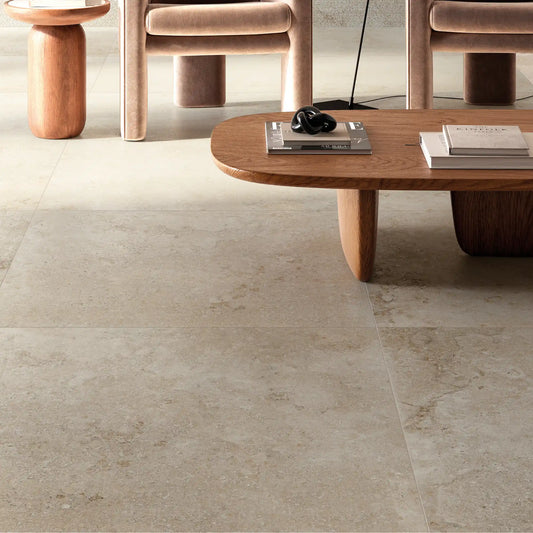
The selection covers six effects, and in a bathroom each answers a different need. Wood effect is the one that takes the utility-room air out of the space: the oak range available runs from white to dark and, unlike parquet, it is unaffected by steam or water. Concrete goes the opposite way, towards the essential, and its greys sit well with wall-hung sanitaryware and dark taps. Stone sits in between, with a range covering both the cool greys and the warm beiges, and it is the broadest in the catalogue.
If instead the room has no window, or only one, light is the front to hold, and the palest tones in the range are the whites of marble-effect porcelain tiles — Statuario and Calacatta — together with the ivories and pearls of the stone effect. Metal brings an industrial register instead, with oxidised surfaces that give the room character, while decoration is dosed on a single portion and is the natural backdrop for the shower wall.
The surfaces and a damp room
The surfaces currently in the range are all matt or satin, and in a bathroom that is the finish that tends to hold the marks of evaporated water less than a reflective surface.
The grout colour counts too, because in a damp room it dirties sooner than elsewhere: a tone close to that of the tile makes it less noticeable and reduces the sense of dirt between one clean and the next.
For the full picture on choosing bathroom tiles — from colours to laying — we have written a dedicated guide.
Frequently asked questions
What sizes do bathroom tiles come in?
Twelve, from 30x60 to 120x120, taking in 60x60, 60x120, 80x80, 90x90, 80x160 and the plank sizes of the wood effect. Availability varies from one effect to another.
Can the same effect be used on the floor and on the walls?
Yes, and it is the most frequent solution. The whole selection is porcelain, so the same surfaces are laid on floors and on walls: the same tone can be used in two different sizes — 60x120 on the floor and 30x60 on the wall, for instance — or the same size throughout for a continuous reading.
Can wood-effect tiles be used in the shower area too?
Yes. Being porcelain, they do not absorb water, do not warp with steam and need no periodic treatment, so they take continuous contact with water like any other effect. It is in fact one of the most effective ways of taking the coldness out of the washing area.