Oxidation or worked sheet metal
With metal-effect tiles the surface almost always has a movement of its own, and what changes is where it comes from. That is the criterion separating the two possible routes, and it is worth settling before looking at sizes.
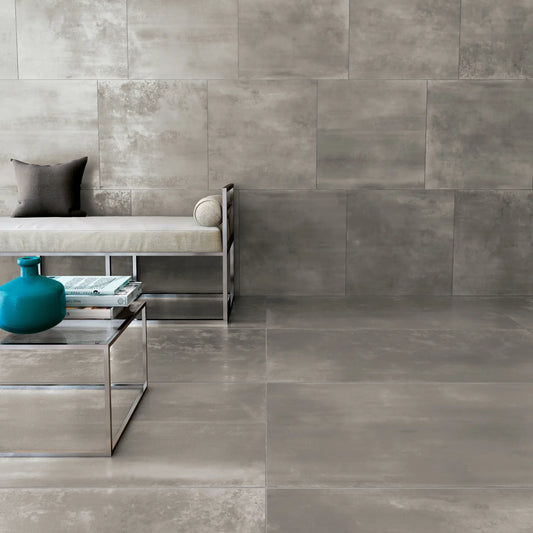
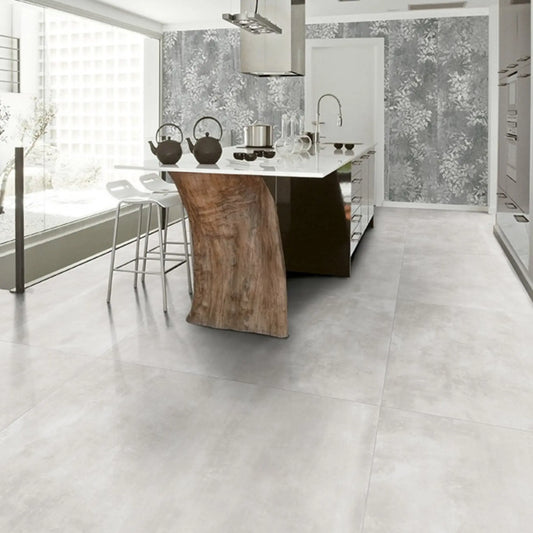
The surfaces with oxidation have a pale ground crossed by darker patches and veils, which vary from tile to tile and give back the look of sheet metal left exposed to time. It is the choice that makes the floor the lead element, and it holds up well in large rooms, where the variation has space to read. The greys instead reproduce the worked sheet: gradations, reflections and rolling marks, a more regular movement that tells of the working rather than the ageing. They give character while leaving the attention to the furniture, and they are the more manageable route in rooms of contained size. On how metal-look surfaces established themselves in contemporary interiors we have written a dedicated piece.
Why size matters
Metal is the effect that depends more than any other on the continuity of the surface: a real metal sheet has no joints, and the sparser the grout lines, the closer the result comes to the original. That is why the selection concentrates on 120x120 and 60x120, which reduce the modular grid to a minimum.
90x90 and 60x60 also remain available, useful in rooms of contained size or where the perimeter is irregular and a large size would produce too many cuts. On small surfaces the difference in result is less noticeable, so the compromise costs little.
Where it works
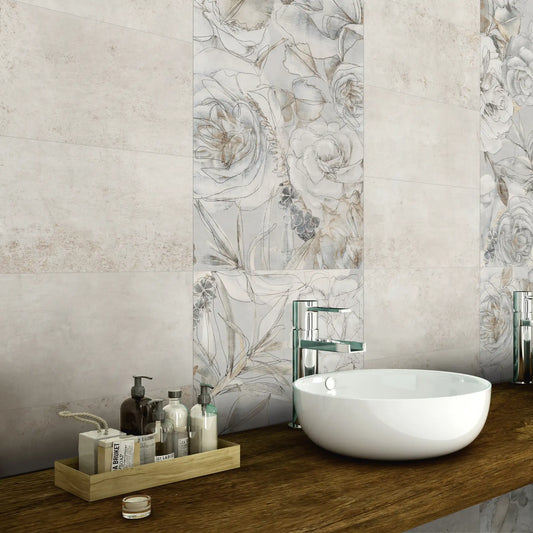
Metal-effect tiles were born in commercial spaces — showrooms, bars, shops — and from there they entered homes. In the kitchen this is the surface that best carries the company of steel and glass, and it works particularly well on the wall behind the worktop, where the splashback becomes a design element rather than a necessity. In the bathroom it builds rooms with a sharp character, above all alongside wall-hung sanitaryware and dark taps.
On pairings, the most solid couple is with concrete-effect porcelain tiles: they belong to the same industrial family and share the neutral range, with the metal bringing the reflection and the concrete acting as the matt ground.
Frequently asked questions
What sizes do metal-effect tiles come in?
Four: 60x60, 90x90, 60x120 and 120x120. Availability varies from one tone to another, and the two large sizes are the ones present across the whole selection.
How much does the surface vary from tile to tile?
On every variant the surface changes from tile to tile, and that is what makes the effect convincing: recognisable repetition is what would give away the ceramic nature of the floor. On the surfaces with oxidation the variation tends to be more evident, because patches and veils spread out irregularly.
Can they be used on floors, or only on walls?
Both. This is porcelain in the full sense, so it takes foot traffic and daily cleaning like any other floor; on walls it is common in kitchens and bathrooms, often coordinated with the same tone on the floor.