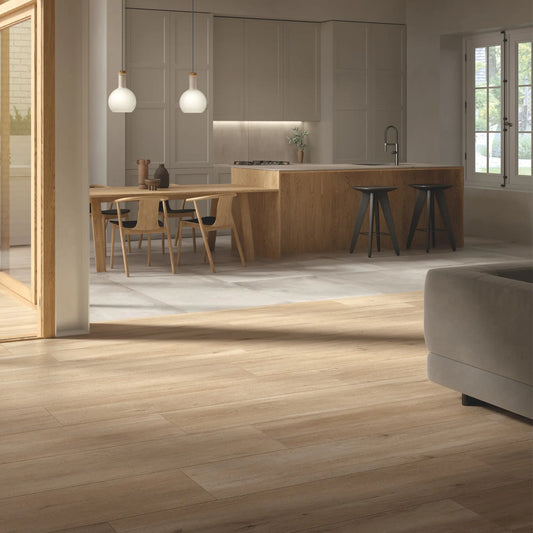
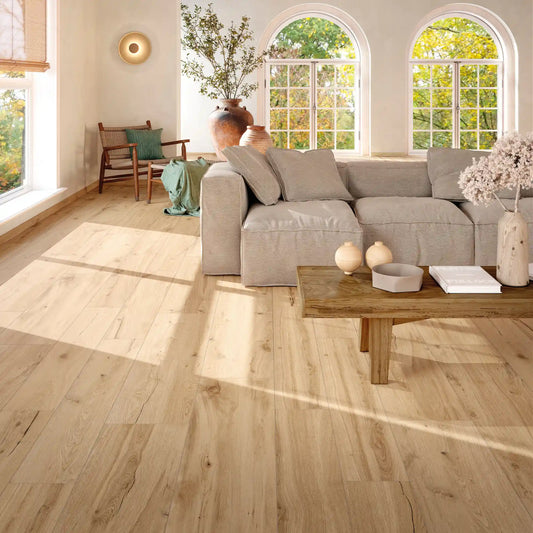
The oak range
Almost the whole assortment interprets oak, the most used timber in contemporary floors, and the choice comes down to the temperature of the tone. Light and bleached oaks visually widen the space and sit well with white furniture and natural materials: they are the most frequent choice in Nordic-leaning homes and where natural light is scarce.
Natural oak is the point of balance, the one that pairs with practically everything and ages best as a decision. Grey oaks cool the wood down and move it into a contemporary register, useful when the furniture is dark or metallic. The dark tones define the room and only hold up where there is enough light: in a small, poorly lit room they close the space in. Alongside oak, the range includes interpretations of other species — ash, chestnut, birch and cherry — set apart by a tighter grain or a warmer temperature. For the full picture — sizes, laying patterns, anti-slip ratings and the comparison with parquet — see the guide to wood-effect tiles.
Plank width and length
Before length comes the width, because that is what decides how closely the floor resembles a traditional parquet or a contemporary wide-board floor. At 120 cm you have two options: 20x120 is the narrow plank, which multiplies the grout lines and gives back the rhythm of classic parquet; 30x120 is wider, reduces the number of joints and reads as a more modern surface. These are the two most requested sizes, and most of the decisions are made between them.
The 26x160 takes the plank to the longest length available, with fewer interruptions and a continuity that shows above all in corridors and in elongated living areas. What counts more than the measurement is that it is available across every collection: whichever tone you choose, the large size stays an option, without giving up the colour to get it.
The 90 cm sizes — 15x90 and 22x90 — remain the choice for small rooms and for a more traditional result, where a long plank would produce too many cuts. There is finally a square coffered size, with an inlay pattern, for anyone who wants the wood look without the directionality of a plank.
Where it works and what it pairs with
Wood-effect tiles solve the rooms where parquet is not practical. In the bathroom they are unaffected by humidity, steam and cleaning products, and they bring the warmth of wood into the shower area as well; in the kitchen they stand up to grease, food acids and frequent washing.
On pairings, the most recurrent combination in contemporary schemes is with concrete-effect porcelain tiles: the wood brings the warm note, the concrete acts as the neutral plane, and the pair is often used to separate the living area from the sleeping area.
Frequently asked questions
What sizes do wood-effect tiles come in?
The planks come in 20x120 and 30x120, in 15x90 and 22x90 and in the large 26x160 size, which is available across every collection. There is also a square coffered size.
Narrow or wide plank?
It depends on the result you are after. The narrow plank multiplies the grout lines and recalls traditional parquet; the wide one reduces the joints and gives a more contemporary look. In small rooms the narrow plank also produces less waste on the perimeter cuts.
Are wood-effect tiles suitable for a bathroom?
Yes, and it is one of their best uses. Unlike parquet, porcelain does not absorb water, does not warp with steam and needs no periodic treatment; it is used both on floors and on walls, shower area included.